

What does it mean to build something well?
In the latest episode of Quality Matters, we sat down with Clint Smith, co-founder of the pioneering email marketing platform Emma, to explore this question through the lenses of entrepreneurship, leadership, and education. Emma helped redefine how private and non-profit organizations communicate with their audiences, but Clint’s reflections extend far beyond email or technology. Having spent time around numerous tech founders and Silicon Valley wannabees, I found Clint’s demeanor particularly refreshing. His style is practically nonexistent in the Valley, where capital is raised on hype, not humility.
Clint’s journey into entrepreneurship didn’t begin with a grand vision or a buzzword-filled pitch deck. It began, as many real ventures do, with uncertainty. After an earlier startup was derailed by the dot-com crash, Clint and his co-founder found themselves motivated by a mix of necessity and curiosity. They didn’t set out to build the biggest company possible. Instead, they wanted to build a company they could be proud of—one that treated people well and created something genuinely useful.[1]
That orientation shaped everything that followed.
Metrics That Matter
In Emma’s early days, success wasn’t measured by hype or press mentions. It came down to a few fundamental questions: Are customers signing up? Are they using the product? And—most importantly—are they coming back?
Those questions may sound obvious, but they reveal something critical. Choices drive higher quality. When customers have alternatives, their decision to stay is meaningful. Clint noted that this same idea translates to education. When families actively choose a school (and continue choosing it year after year), that decision tells us far more than compulsory, zone-driven enrollment ever could.
Just as important was how Emma handled data. While email marketing generates endless metrics—opens, clicks, impressions—Clint emphasized the danger of confusing information with insight. Emma worked to simplify complexity, rolling data into clearer, goal-oriented signals that aligned with what customers actually cared about. In education, where data can easily become noise, the lesson is clear: metrics should illuminate purpose, not obscure it.
My co-host Caitlin and I think about this a lot in terms of education. Just as in tech, there seems to be an inexhaustible amount of data that could be reported on in K-12 education. But does that data actually tell decision-makers what they need to know? While it’s fashionable to malign the No Child Left Behind Act (NCLB) as top-down, federally mandated ed reform, critics often forget that prior to NCLB, the data made available to parents was generally useless. Academic measurements were not disaggregated. In other words, a parent might know that a local elementary school was rated an “A” according to the state’s rubric.
But what about the 5th grade?
And what about boys?
And what about boys in the 5th grade with special needs?
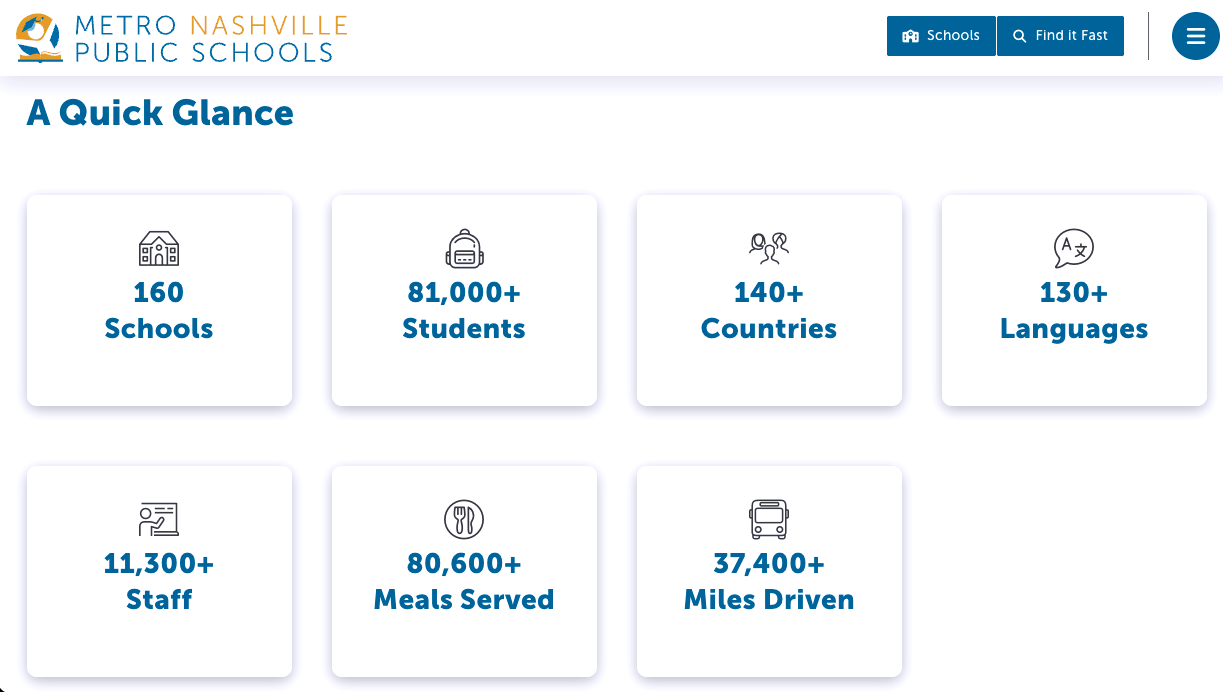
That’s an example of a lack of data, but the opposite, as in the case of metrics that Clint described, can be just as pointless. Take the example of the district in which I live. The “About Us” page informs visitors of key district data points. Among them: the district has “160 schools,” “140+ Countries,” “80,600+ Meals Served,” and “37,400+ Miles Driven.”
No context is given.
Are 80,600+ miles driven per day? Per week? By whom?
Likewise, did students visit 140+ countries? Were students in Nashville born in all but 55 countries in the world?
Moreover, how do these bits of information help a parent determine whether the school is best for a specific child? As Clint noted during our conversation, metrics are most meaningful when they provide the end user with actionable information.
Culture Is Not a Poster on the Wall
One of the most compelling parts of Clint’s story is how intentionally Emma approached culture. Rather than importing Silicon Valley clichés or chasing “move fast and break things” energy, Emma focused on transparency, trust, and shared ownership.
Weekly all-hands meetings ensured everyone understood the company’s goals and how their work connected to them. A written culture guide explained not policies, but why the company existed. Peer-driven recognition—like “Kick-Ass Cards” that employees could give one another—reinforced accountability and appreciation without hierarchy.
The result? A brand experience that was consistent throughout the organization. Customers encountered the same competence and clarity whether they spoke to sales, support, or leadership. That consistency was a direct reflection of how people inside the company felt about their work.
For schools, this lesson is powerful. Culture is not what’s printed on a banner or t-shirt. It’s what families experience at every touchpoint. And it always flows from leadership.
A North Star—and the Freedom to Personalize
Clint also emphasized the importance of a clear, shared North Star. For Emma, that meant profitability at one stage and a successful exit at another. Transparently declaring the goal focused decision-making and aligned the team.
But clarity of purpose didn’t mean rigidity. Underneath that North Star was a commitment to personalization—treating customers, employees, and eventually students as individuals with distinct goals and strengths.
In education, Clint argued, personalization shouldn’t be a luxury. It’s foundational. As a father, he advocates for helping students imagine futures that reflect their interests and abilities, rather than forcing them into generic pathways. That customization didn’t exist for many of today’s parents when we were young, but the fusion of adaptive learning tools and choice programs is disrupting[2] the education status quo. Our kids needn’t be conscripted to the local, zoned school. States like Florida, Indiana, and Ohio show that thoughtful policies enable families to customize education in ways that were unimaginable even 10 years ago.
In the end, Clint’s story is a reminder that quality is not abstract. It’s built deliberately, sustained through feedback, and expressed through culture. Whether in startups or schools, the work is the same: define what matters, align around it, and treat people like they truly have a choice—because they do.
[1] How I wish Clint had co-founded Twitter.
[2] I couldn’t write an entire piece about tech without using the “d” word.


